Is Moving Into A Brand New Home The Right Move?

A newly built home is one of the few situations where a mold-sensitive person gets to start from a clean slate — no unknown history of roof leaks, no decade of quiet condensation inside the walls. But new construction trades one problem for another: a sealed box full of materials that are actively off-gassing. This is the short, honest version of a decision that usually gets argued badly, with links to the deeper pieces where each part deserves more room.

The short answer
For most people with a mold sensitivity, a newly built home is a better starting point than an older one. An older building carries an unknown history of water — and you cannot audit it. A new building's main risk, formaldehyde and solvent off-gassing, is front-loaded, measurable, and fades over months. Known-and-shrinking beats unknown-and-permanent.
But the answer is conditional, and the condition is specific.
The deciding question: was this building constructed dry, and can you tolerate three to six months of chemical off-gassing while you manage it down? Everything below is about answering those two questions for one specific address.
One caution up front, because it is the most common mistake: after being sick in a water-damaged building, people learn to read every symptom as a mold detector. In a new build, the same headache and fog usually mean formaldehyde, not mold — a different problem with a different fix. Don't let one exposure diagnose the next one.
Two problems that feel the same
A water-damaged building exposes you to spores, fungal fragments, the musty gases called mVOCs, and sometimes mycotoxins. A new building's profile is dominated by one thing: formaldehyde from engineered wood — cabinet boxes, subfloor, trim — plus solvent VOCs from paint, adhesives, and finishes. They are chemically unrelated but they hit the same immune machinery, which is why they feel identical from the inside.
- Mold exposure symptoms — what's actually established, and what isn't.
- Formaldehyde in a new build — where it comes from and what filters do (and don't) touch it.
- A musty smell with no visible mold — what that actually means before you panic.
- Mold vs. VOCs — the two exposures side by side, and the differences you can actually use.
- What a water-damaged building exposes you to — spores, fragments, mVOCs, and the contested part.
- Why the two feel identical — and the three instruments that settle it when your symptoms cannot.
- What mast cells actually do — the sentries at your boundaries, and the three diagnostic criteria stated precisely.
- The MCAS diagnosis controversy — two frameworks share one name; what each side is protecting.
- Why both exposures trigger mast cells — non-IgE pathways, the load model, and loss of tolerance.
The case for a new build
- No accumulated water history — the single strongest argument, and it isn't close.
- Cabinet formaldehyde is federally capped now (TSCA Title VI); a compliant 2026 build emits meaningfully less than a build from fifteen years ago.
- Modern envelope and moisture detailing, when built to current code and inspected competently.
- A clean baseline: if you test and it's clean, that result actually means something.
The thread running through all four is moisture. New or old, the real question is whether the building is dry — see why mold is a moisture problem, not a cleaning problem.
The case against
- The chemical load is real and front-loaded — paint clears in weeks, but cabinets can off-gas for months.
- Wet framing closed in behind drywall — the failure mode that quietly undoes the whole “no water history” advantage, and it's invisible on a walkthrough.
- Tight, well-sealed envelopes concentrate everything indoors unless mechanical ventilation (an ERV or HRV) is actually commissioned.
- Ground floors and slabs concentrate moisture risk.
- No track record — an older unit has already revealed its failure modes; a new one hasn't.
- What a new build off-gasses — formaldehyde, solvent VOCs, and the four things that actually reduce them.
- Water damage vs. new construction, side by side — unknown-and-permanent against known-and-shrinking.
- The off-gassing timeline by material — what the three-to-six-month window is actually made of.
- Special cases by building type — renovations, condos, sealed high-rises, manufactured homes and ADUs.
- New-home air quality by climate — the same building fails differently in five climates.
Most of these come down to humidity and drying. Keep a hygrometer in the 30–50% band (the 30–50% rule, explained), and if a space runs wet, a right-sized dehumidifier is a better health purchase than a second air purifier.
The one-hour pre-signing protocol
This takes about an hour and costs under $60 in equipment you keep. Run it before you sign anything. Bring a pin-type moisture meter and a hygrometer, and check — in order — under every sink, the patio-door threshold, weather-facing window sills, the HVAC condensate pan, the water heater pan, the base of exterior walls, and the bathroom exhaust fan.
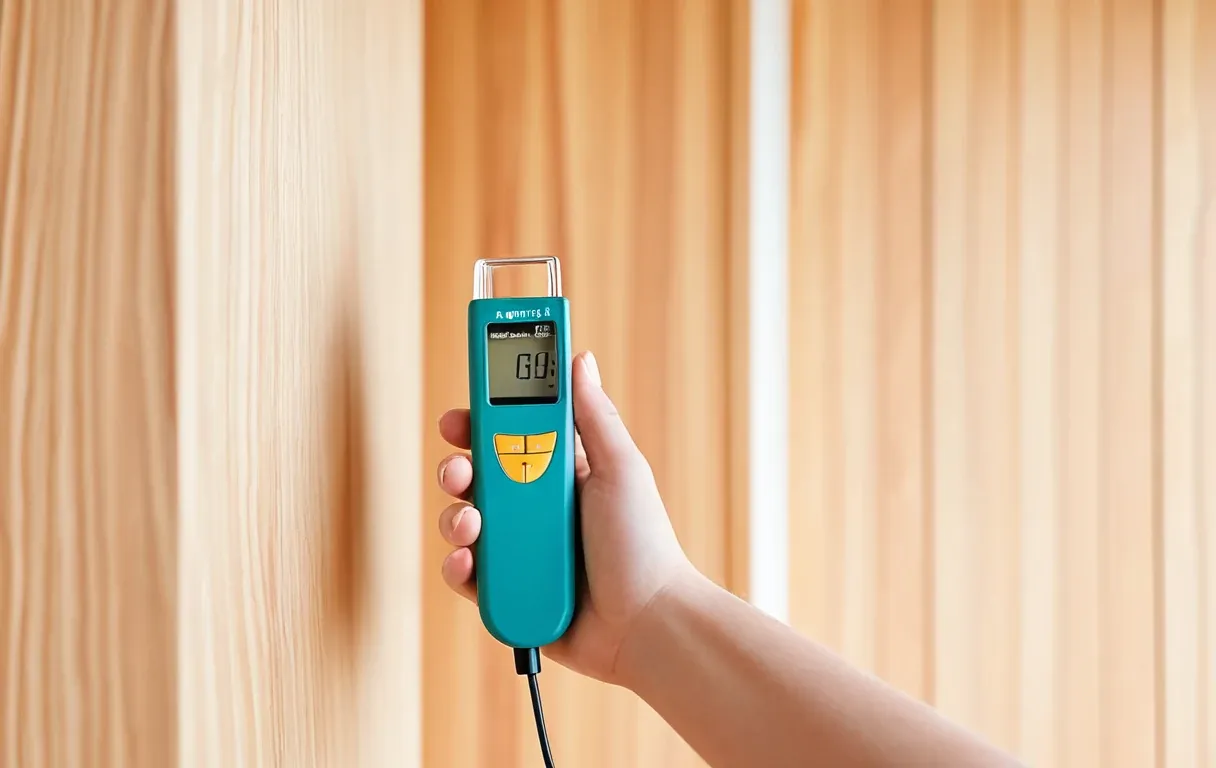
Good readings: wood moisture under 15%, indoor humidity 30–50%. Anything over 19% moisture is a stop-and-investigate. A meter reading is a snapshot, so also put your questions to the builder in writing — especially whether the framing was rained on during construction and whether its moisture was verified before the walls were closed.
- Which mold test tells you what — moisture meters, dosimeters, spore traps, and where each one earns its keep.
- ERMI vs. HERTSMI-2 — what the dispute is really about before you pay for one.
- The DIY walkthrough inspection — eight places to check in order, and the six questions to put in writing.
- What your moisture readings should say — the thresholds, and why a clean reading is news about today only.
If you sign: the first 90 days
The highest-value moves cost nothing. Open every cabinet and drawer — formaldehyde concentrates in closed casework. Cross-ventilate so air actually moves through. Hold humidity in the 30–50% band. Filtration is what you use when you can't ventilate — at night, in winter, during wildfire season.
The one principle purifier marketing obscures: match the media to the molecule. HEPA captures particles and does nothing for gases; a new build's problem is a gas, so you need activated carbon, ideally impregnated for formaldehyde.
- HEPA vs. carbon — why a HEPA-only purifier isn't helping with off-gassing.
- The right air purifier — matched to your rooms, budget, and whether the problem is spores or gases.
- The right HVAC filter — MERV, airflow, and the tradeoff nobody mentions.
- The new-home decision framework — four questions in the order they actually matter.
- Your first 90 days, month by month — the free moves first, equipment second.
- VOC and formaldehyde certifications — what each mark tests, and what none of them promise.
The decision, in one line
If you take one idea from this, make it this one: the useful question is not new versus old. It is dry versus wet, and managed versus ignored. A dry new build you actively air out beats a wet one you hope about — and beats an older building whose water history you can't see.
Go deeper
Each part of this decision has its own full guide:
Symptoms & health
- Mold exposure symptoms: what's established and what isn't
- Mold detox: what the evidence actually supports
Mold vs. new-build exposure
- Mold vs. VOCs — the two exposures side by side, and the differences you can actually use.
- What a water-damaged building exposes you to — spores, fragments, mVOCs, and the contested part.
- Why the two feel identical — and the three instruments that settle it when your symptoms cannot.
Testing
- The best mold test kit: what each type actually tells you
- ERMI vs. HERTSMI-2: what the dispute is actually about
Moisture & humidity
- Mold is not a cleaning problem — it's a moisture problem
- What humidity level prevents mold? The 30–50% rule
- The best dehumidifier for a basement or crawl space
Air & filtration
- The best air purifier for mold
- HEPA vs. carbon: why your purifier isn't helping
- The best HVAC filter for mold spores
- Does AirDoctor remove formaldehyde?
Cleanup & remediation
- Does bleach kill mold? No — and here's why
- Can you save clothes after mold exposure?
- How to choose a mold remediation company
- How much does mold remediation cost?
If you're renting
New construction & off-gassing
- What a new build off-gasses — formaldehyde, solvent VOCs, and the four things that actually reduce them.
- Water damage vs. new construction, side by side — unknown-and-permanent against known-and-shrinking.
- The off-gassing timeline by material — what the three-to-six-month window is actually made of.
Buying and settling a new build
- The new-home decision framework — four questions in the order they actually matter.
- Your first 90 days, month by month — the free moves first, equipment second.
- VOC and formaldehyde certifications — what each mark tests, and what none of them promise.
Mast cells, MCAS and the shared mechanism
- What mast cells actually do — the sentries at your boundaries, and the three diagnostic criteria stated precisely.
- The MCAS diagnosis controversy — two frameworks share one name; what each side is protecting.
- Why both exposures trigger mast cells — non-IgE pathways, the load model, and loss of tolerance.
Checking a building yourself
- The DIY walkthrough inspection — eight places to check in order, and the six questions to put in writing.
- What your moisture readings should say — the thresholds, and why a clean reading is news about today only.
Before you decide
- Five beliefs worth retiring — each is a reasonable generalisation that breaks in the specific case.
When the general answer does not fit
- Special cases by building type — renovations, condos, sealed high-rises, manufactured homes and ADUs.
- New-home air quality by climate — the same building fails differently in five climates.
Questions people actually ask
- Mold and new homes: the FAQ — how long until it settles, what no smell means, and whether any level is safe.
Take the moisture meter with you when you go look at the place. It is the most useful thirty dollars anyone in this situation can spend.
This guide is educational and environmental information. It does not diagnose, treat, or prevent any condition. Work with a qualified clinician on health decisions and with licensed professionals on remediation.
Sources and further reading
This article is educational guidance, not medical advice. The primary sources below inform this section of the site — each is republished here in full, and linked to the original publisher so you can read it at the source.
- EPA — What Are Volatile Organic Compounds (VOCs)? — original at epa.gov
- EPA — VOCs' Impact on Indoor Air Quality — original at epa.gov
- CPSC & EPA — The Inside Story: A Guide to Indoor Air Quality — original at cpsc.gov
Looking for the right gear?
Browse the full toolkit by category.
Educational Disclaimer
This content is educational and does not constitute medical advice, diagnosis, or treatment. Mold-related illness is an area where the science is still developing — where a claim is contested, the article says so. Always work with a qualified clinician on health decisions, and with licensed professionals on remediation. Some links may be affiliate links; that never changes a recommendation.